
Slope & Rockfall Protection
Holding unstable ground in place.
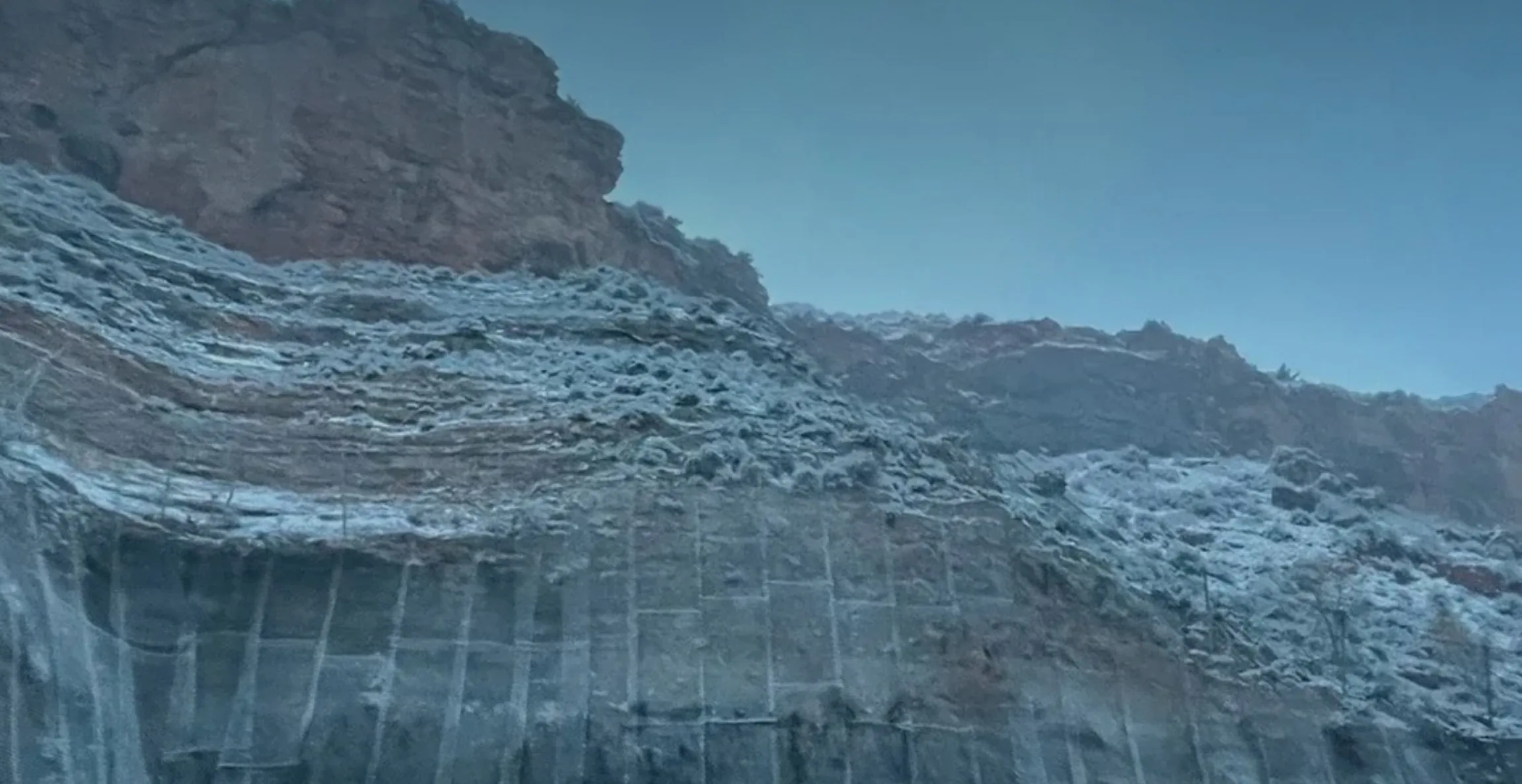
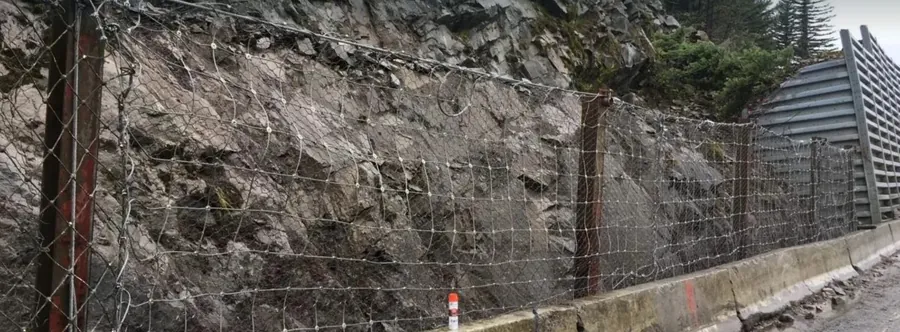
Anchored mesh on a rock cut slope
Mesh, anchors, nets and barriers that hold loose material at source, or catch it and guide it safely to a catchment.
A rock or soil slope fails in one of two broad ways. Material either breaks away and falls, or a shallow layer slides. Which of the two applies, and how large the blocks or the slide are, decides the system.
We either hold the material at source with anchored mesh, nets and anchors, or we let it move and guide it into a catchment. Flexible barriers cover the larger blocks and higher energies. Most schemes combine more than one of these systems along the same slope.
In this family: 12 systems
Jump to the selection guideNatural Hazard Mitigation
Integrated systems that intercept or control rockfall, debris flow, shallow slides and snow before they reach protected assets.
Most hazard slopes need more than one measure. We combine mesh, anchors, nets, barriers and drainage into one scheme, so that each part works at the point in the slope where it is most effective. Hazard mapping, expected block sizes and runout paths set the layout. Where the source cannot be reached, interception and catchment take over from containment at source.
Simple Drapery
Steel wire mesh hung over a rock face and anchored at the crest, guiding loose rock to a catchment at the toe.
Mesh is hung from crest anchors and left free over the face, so that small blocks and loose debris travel down behind it and settle in a ditch or catchment at the toe. It suits faces where the rock is generally sound and the hazard is frequent small falls. It does not pin the face, so the toe catchment must be sized for the volume the mesh will collect.
Secured Drapery
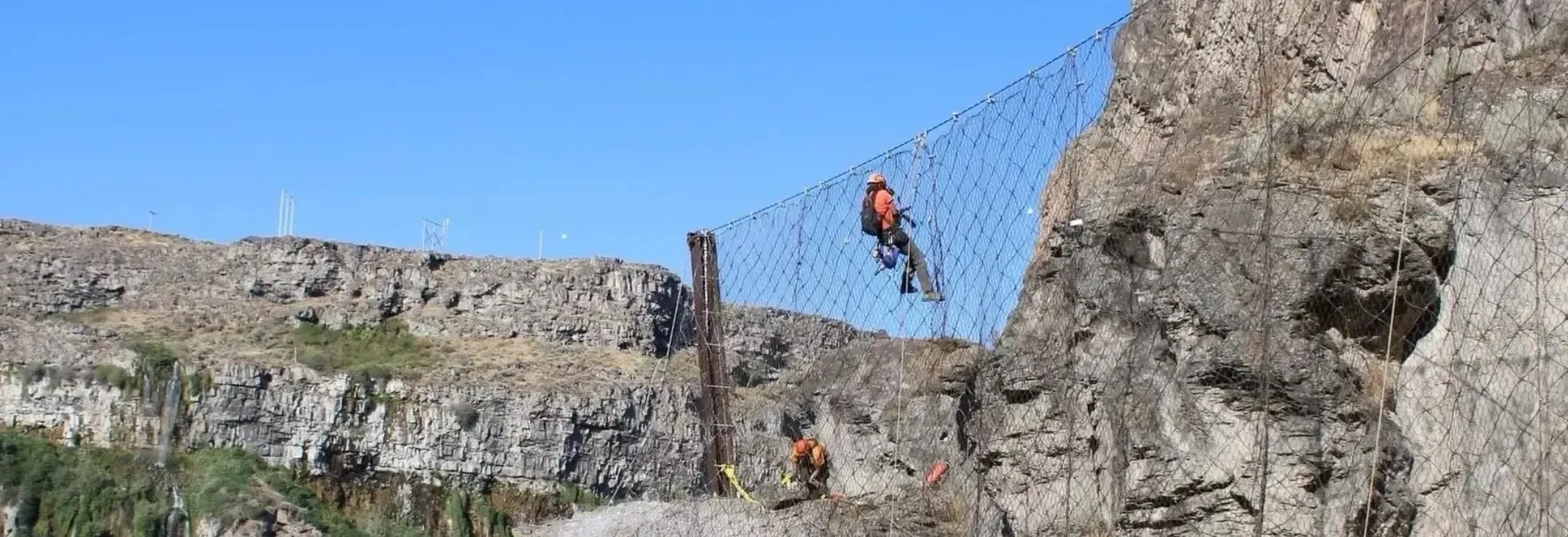
Mesh pinned to the slope with anchors on a regular grid, holding loose material in place at source.
The mesh is fixed to the face on a regular grid of anchors and tensioned against it. Loose rock stays where it is rather than moving behind the mesh. Anchor length, spacing and the mesh grade follow the block size and the condition of the rock. Secured drapery is the usual choice where there is little room at the toe for a catchment.
Steel Wire Mesh & Weld Mesh
Double-twist hexagonal and high-strength mesh for facing and drapery; welded panels where a rigid face is needed.
Double-twist hexagonal mesh unravels slowly if a wire is cut, and it accommodates uneven faces. High-strength mesh carries higher loads at the same opening size. Welded mesh panels give a stiff face for shotcrete reinforcement and for the faces of reinforced soil walls. Wire coating, aperture and wire diameter are chosen against the exposure and the expected load.
Self-Drilling Anchors
Hollow-bar anchors drilled and grouted in one operation. Suited to loose ground where boreholes collapse, for soil nailing and slope anchoring.
A hollow bar carries the drill bit and the grout. The hole is drilled and grouted in a single pass, with no separate casing, so the method works in weathered rock, boulder fill and collapsing soils where open holes will not stand. The bar is then the nail or anchor. Pull-out tests on trial anchors confirm the bond before production begins.
High-Tensile Rope Net System
Flexible nets of high-tensile steel wire rope, anchored over unstable slopes to restrain rock and soil with high load capacity.
Panels of interlaced high-tensile wire rope are laid over the slope and tied to rows of anchors. The net restrains both rock blocks and the soil between them, and its flexibility lets it follow the face. It is used where mesh alone has too little capacity, such as larger blocks and steeper faces. The rope diameter and anchor pattern are set by design.
Rope Net Slope Stabilisation
Anchored rope-net systems for shallow and localised instability on steep cut slopes.
Where the failure surface is shallow, a rope net anchored beyond it can hold the surface layer in place. It is used on steep cuts in weathered rock and on soil slopes with localised instability. Nets are often combined with a vegetation or erosion layer beneath, so that fine material does not wash out through the openings.
Ring Nets
Interlinked rings of high-tensile wire forming flexible, high-energy-absorbing nets for barriers, drapery and debris control.
Each ring is wound from several turns of high-tensile wire and linked to four neighbours. The net deforms under impact and spreads the load across many rings. Ring nets are used as the panels of high-energy rockfall barriers and as drapery where blocks are large. Energy capacity depends on the ring type, the support ropes and the brake elements.
Rockfall Barriers
Flexible barriers that catch and absorb the energy of falling rock, mid-slope or at the toe.
A flexible barrier is a net on posts held by ropes and anchors. A falling block stretches the net, and brake elements in the ropes absorb the energy. Barriers are placed across the fall path, either mid-slope or at the toe beside a road or structure. The design height and energy class follow the rockfall analysis. After an event the barrier is inspected and emptied.
Flow Barrier Systems
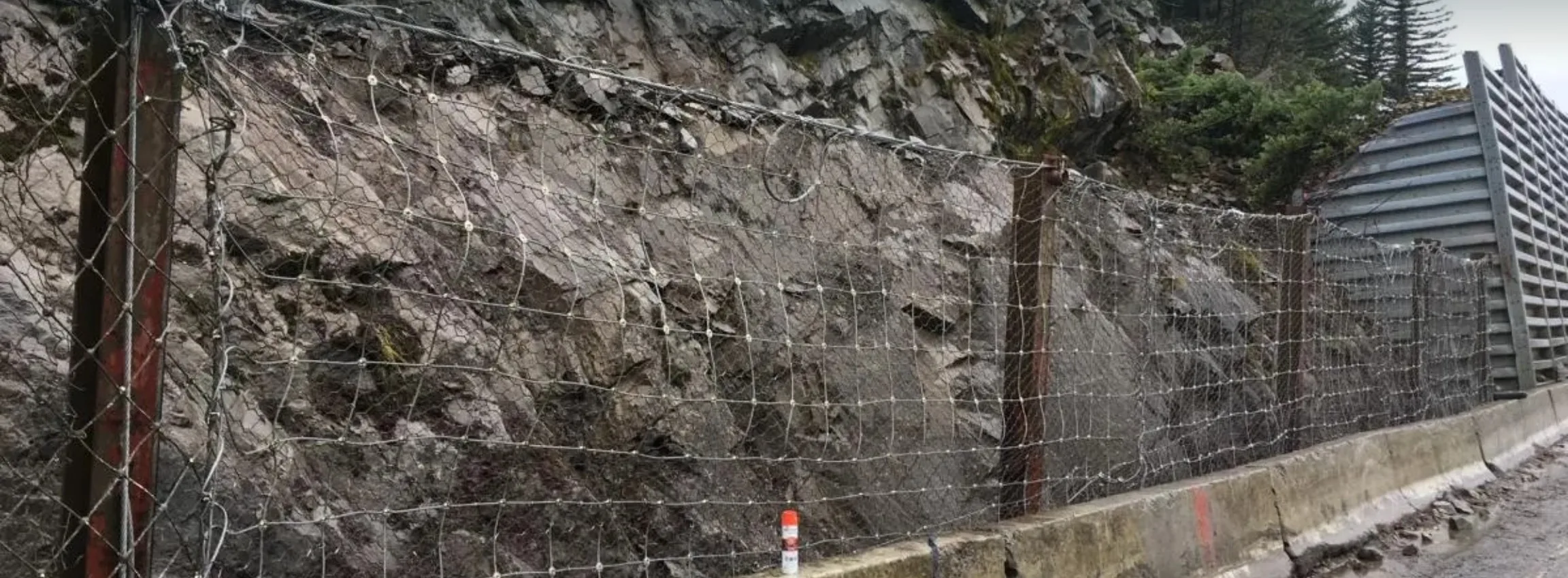
Barriers across drainage channels that stop debris flow while letting water pass.
Debris flows follow existing channels. A flow barrier spans the channel with a net that retains boulders, timber and mobilised soil, while clear water passes through. The barrier is anchored into stable banks. Sizing follows the expected flow volume and velocity, and the retained material has to be removed after events so that capacity is restored.
Avalanche Protection
Snow-supporting structures that hold the snowpack in the release zone.
Snow-supporting structures are built in the zone where an avalanche starts. They hold the snowpack on the slope so that it cannot accelerate into a slide. The layout, row spacing and structure height follow the snow depth and the slope angle. They are used on mountain roads and at facilities in snow-prone terrain.
Rapid Slope Consolidator
A fast-install system for urgent remedial work with minimal disruption to traffic.
After a slip or a rockfall on an operating road, time matters. This is a system chosen for speed of installation, so that the slope can be secured and the carriageway reopened with the least possible disruption. It is a first measure, and a permanent scheme can follow once the site has been investigated.
Selection guide
Match the hazard to the system.
A first guide only. Final selection follows site investigation and design loads.
| Situation on site | Suitable systems |
|---|---|
| Loose rock and small blocks on a face | Simple drapery, secured drapery, steel wire mesh |
| Blocks to be held at source | Secured drapery, rope nets, self-drilling anchors |
| Large blocks, high impact energy | Rockfall barriers, ring nets |
| Debris flow in channels | Flow barrier systems |
| Steep or excavated slopes losing stability | Rope net stabilisation, soil nailing and shotcrete, anchors |
| Avalanche release zones | Avalanche protection systems |
| Urgent work, minimal disruption | Rapid slope consolidator |
Where this family works
Roads, Highways & Rail
RS walls and embankments, weak-subgrade stabilisation and cut-slope protection.
Hill Slopes & Mining
Drapery, rope nets, barriers and anchoring for rock and soil slopes.
Planning slope & rockfall protection works?
Send the plan or section, the soil or rock report and the design loads. We typically respond within one working day.